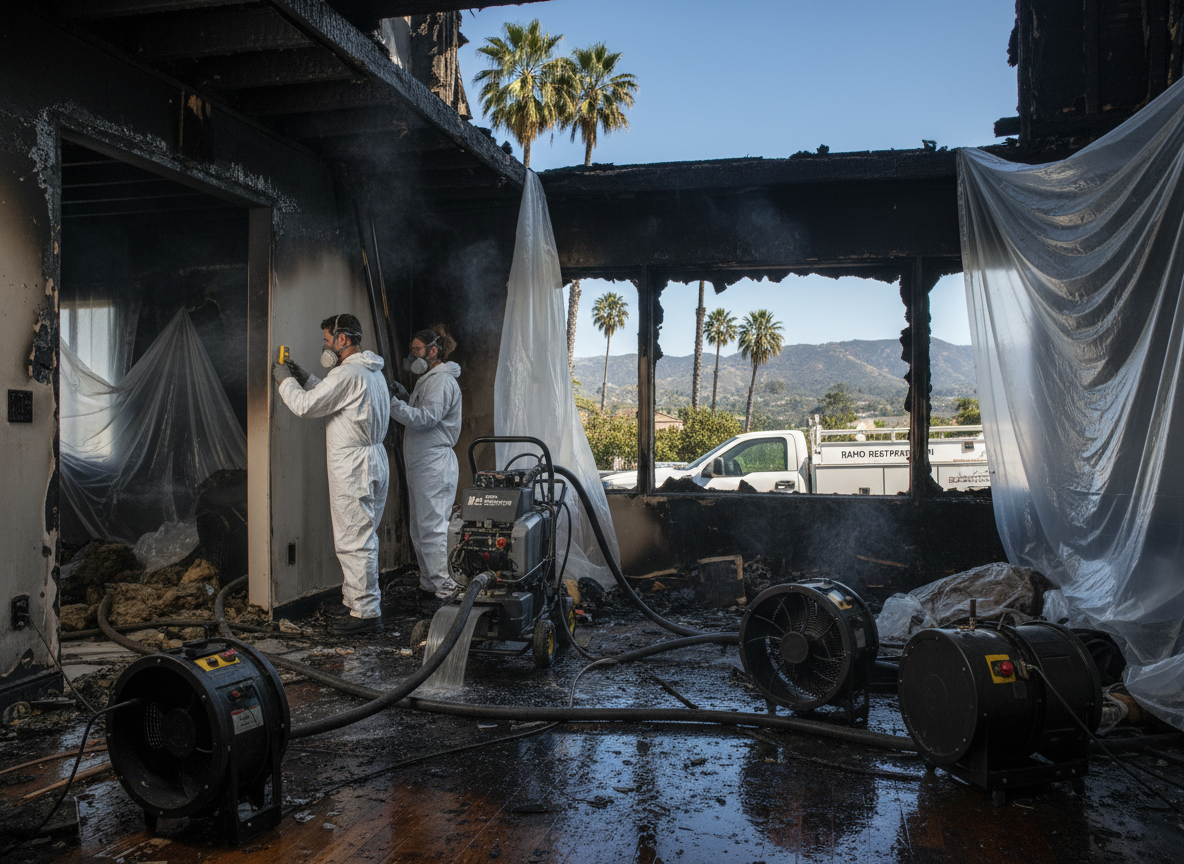
Pacific Palisades homes in neighborhoods like Castellammare and Marquez Knolls often date from the mid-century and feature wood framing, plaster walls and hillside foundations that trap water from firefighting efforts. When flames are extinguished, residual moisture migrates into subfloors and wall cavities, especially during the area's mild coastal Mediterranean climate where foggy mornings slow natural evaporation. Crews must extract standing water immediately, then deploy commercial drying equipment calibrated for the salt air that accelerates corrosion on metal lath and electrical boxes common in these properties.
Firefighting water in Los Angeles County frequently carries sediment from nearby canyons that can stain hardwood floors and saturate insulation in older homes near Will Rogers State Historic Park. Remediation teams separate affected materials early because soot bonds differently to painted plaster versus unpainted wood, requiring targeted cleaning agents that will not damage original finishes. In The Village and areas close to Pacific Palisades Park, narrow lots and shared driveways limit equipment access, so technicians often stage dehumidifiers through side entries and monitor moisture readings for several days to prevent hidden mold growth behind built-in cabinetry.
After initial extraction, air movers and desiccant dehumidifiers run continuously while crews test drywall and ceiling joists for hidden saturation. Homes near Temescu Park sit on slopes where water can migrate downslope into lower levels, creating edge cases that demand infrared imaging before any reconstruction begins. Technicians also address smoke residue on HVAC systems that distribute particles through the mild climate's typical ventilation patterns, ensuring return air paths are cleaned to prevent recontamination once power is restored.
Technician insight
In Pacific Palisades, the thing that catches most people out with water damage remediation after fire is how the coastal fog keeps older plaster and lathe walls in Castellammare homes from drying on their own. Homeowners often assume once the visible water is gone the job is done, but the salt air and morning moisture push hidden saturation deeper into framing near shared property lines.
Firefighter Water in Marquez Knolls Home
A kitchen fire in a mid-century home sent water through the floor into the crawlspace. Inspection showed sediment-laden water had traveled downslope and saturated insulation under the living room. Extraction and targeted drying prevented mold while preserving original hardwood that had not yet absorbed the residue.
How it works
- 1
Emergency Assessment
Technicians arrive within hours, document water intrusion points from firefighting and test moisture levels throughout the structure.
- 2
Water Extraction
Standing water and saturated materials are removed using truck-mounted pumps and portable extractors suited to hillside access in Pacific Palisades.
- 3
Drying and Monitoring
Industrial drying equipment runs while daily moisture readings track progress in wood framing and plaster common to local homes.
- 4
Soot and Residue Cleaning
Affected surfaces receive appropriate cleaning to remove smoke and sediment before any reconstruction work begins.
- 5
Final Verification
Independent moisture and air quality checks confirm the home meets dry standards prior to returning it to the owner.
Pricing
Pricing varies by extent of water migration, number of affected levels, and access constraints typical of Pacific Palisades hillside lots; upfront written estimates are provided after inspection.