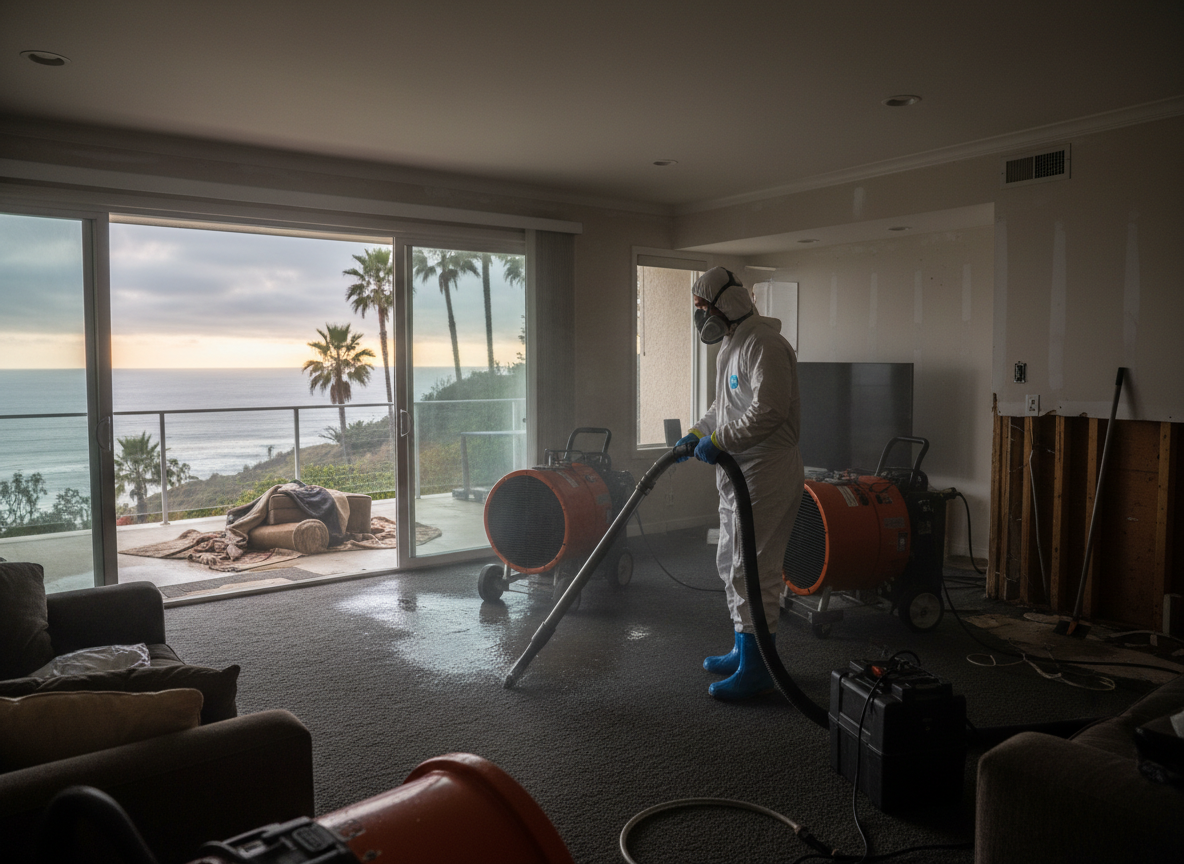
Pacific Palisades homes built decades ago in The Village and Castellammare often feature stucco over wood framing and shallow crawlspaces that trap water when coastal fog rolls in during mornings. Salt air from the nearby ocean accelerates corrosion on metal fixtures and underfloor pipes, so extraction must include checking for hidden saturation behind walls before mold sets in within 48 hours. Los Angeles County building codes require proper disposal of contaminated materials, and crews working near Will Rogers State Historic Park or Pacific Palisades Park must navigate narrow hillside access roads that limit equipment size.
Terrain in Marquez Knolls slopes toward Temescu Park drainage paths, meaning runoff from heavy winter rains can back up into lower-level garages and basements faster than in flat Santa Monica neighborhoods. Technicians use moisture meters on concrete slabs common in these properties because surface drying alone leaves residual humidity that reactivates when fog returns. Upfront assessment at the 960 Monument St base determines whether dehumidifiers need to run longer in older insulation types that absorb and hold water compared to modern materials.
Edge cases include sewage backups during storms when municipal lines in lower Pacific Palisades areas overflow, requiring full PPE protocols and separate equipment to avoid cross-contamination. Crews also watch for electrical hazards in homes where outdated wiring meets standing water, shutting off power before extraction begins. All work stays within Los Angeles County health guidelines for drying times and documentation.
Technician insight
In Pacific Palisades, the thing that catches most people out with Emergency water cleanup is how foggy mornings let moisture creep back into the older stucco and crawlspace homes in The Village and Marquez Knolls even after extraction, especially when the hillside terrain funnels extra runoff toward lower lots near Temescu Park.
Pipe failure in Castellammare residence
A supply line split behind a kitchen wall during a cool night. Water migrated into the subfloor and along the slope toward the garage. Extraction targeted the crawlspace and wall cavities, followed by targeted drying equipment. Readings reached dry standards within four days with no further migration.
How it works
- 1
Initial Assessment
Technician arrives within the service window, maps water migration through the property using meters, and identifies affected materials in crawlspaces or wall cavities typical of Pacific Palisades construction.
- 2
Water Extraction
Portable pumps and wands remove standing water from floors and low areas, with special attention to hillside drainage patterns that funnel moisture into lower levels of Castellammare homes.
- 3
Drying and Dehumidification
Industrial air movers and dehumidifiers target residual moisture in stucco walls and older insulation, monitored daily to prevent fog-driven reabsorption common in the mild coastal climate.
- 4
Final Verification
Moisture readings confirm dry standards before any reconstruction, with documentation provided for insurance and Los Angeles County compliance.
Pricing
Upfront quotes based on inspection, no hidden fees.