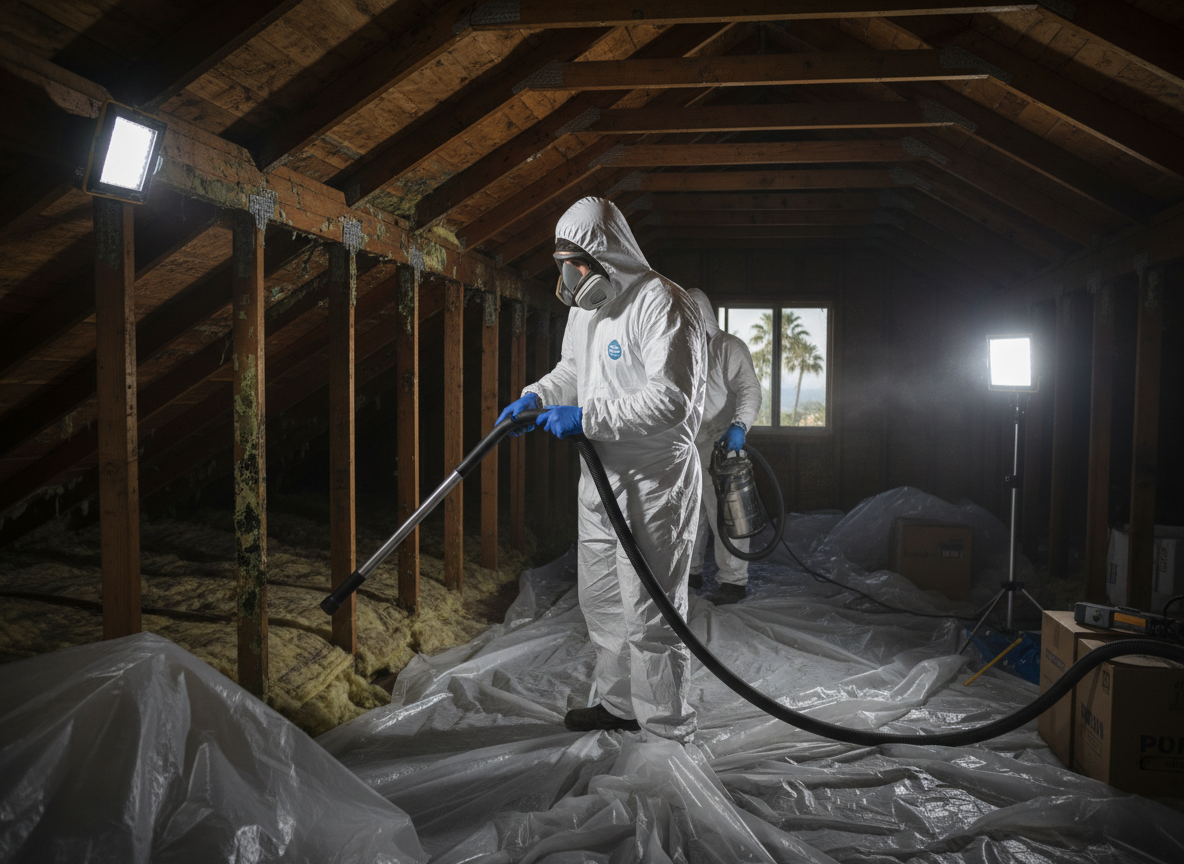
Pacific Palisades homes built before 1970 often feature vented attics with limited insulation and original cedar shake or composition roofing that traps moisture from the mild coastal Mediterranean climate. Foggy mornings common along the coast roll into neighborhoods like Castellammare and Marquez Knolls, raising relative humidity in roof cavities where bathroom and kitchen exhaust fans terminate. This creates conditions for Stachybotrys and Aspergillus growth on rafters, sheathing, and insulation batts. Remediation requires full containment with negative air machines exhausting through upper vents to avoid spreading spores into living spaces below, followed by HEPA vacuuming and removal of porous materials that cannot be dried below 12 percent moisture content.
Los Angeles County building codes require proper ventilation ratios and vapor barriers in any re-insulation work after mold removal. In homes near Will Rogers State Historic Park or Pacific Palisades Park, steep terrain and mature tree cover reduce airflow around eaves, making standard fan setups insufficient. Technicians must often install temporary ridge vents or use desiccant dehumidifiers sized for the actual cubic footage rather than relying on refrigerant units that struggle in the 65-70 degree foggy conditions. Edge cases include knob-and-tube wiring in pre-1950 Castellammare cottages, where any wet insulation removal must be coordinated with licensed electricians to avoid code violations during reassembly.
Homeowners frequently discover attic mold only after noticing ceiling stains in upper bedrooms during the winter months when indoor heating drives moist air upward. Delaying inspection allows colonies to colonize HVAC ducts that run through the attic space, turning a localized issue into whole-house contamination. Proper remediation includes pulling back insulation at all plumbing stacks and exhaust terminations, treating sheathing with EPA-registered antimicrobials, and verifying clearance with post-remediation air sampling before reinstalling insulation to R-38 levels required for the local climate zone.
Work in The Village and adjacent streets must account for narrow driveways and hillside access that limits equipment staging. Crews stage containment tunnels from the exterior where possible to keep foot traffic out of finished interiors. All debris is double-bagged and removed through roof access points to minimize tracking through the home.
Technician insight
In Pacific Palisades, the thing that catches most people out with attic mold remediation is how the daily fog in Castellammare and Marquez Knolls keeps rafters damp even when the rest of the house feels dry. Homeowners often seal bathroom fans into the attic thinking they are venting moisture out, but that just pumps humid air straight into the space where it condenses overnight.
Hidden Mold Above Upper Bedrooms in The Village
A homeowner in The Village noticed recurring ceiling spots after several foggy weeks. Inspection revealed mold on rafters and insulation where an old bathroom fan terminated inside the attic. Containment was set from the exterior, affected materials removed, and the fan extended through the roof. Clearance samples passed and new insulation was installed with improved ventilation.
How it works
- 1
Initial Inspection and Moisture Mapping
Technicians enter the attic from exterior access points when available, using moisture meters and infrared cameras to identify hidden wet zones behind insulation without disturbing the entire space.
- 2
Containment and Negative Air Setup
Plastic sheeting and zipper doors isolate the attic from living areas while HEPA-filtered negative air machines exhaust spore-laden air safely outdoors.
- 3
Removal of Affected Materials
Porous insulation, drywall, and heavily colonized wood are cut out and bagged for disposal; non-porous surfaces receive antimicrobial treatment and agitation.
- 4
Drying and Verification
Desiccant dehumidifiers and air movers bring moisture content below 12 percent, followed by clearance air sampling before any new insulation is installed.
- 5
Prevention and Documentation
Exhaust fan terminations are extended, ventilation is improved where possible, and a written report with photos is provided for homeowner records.
Pricing
Pricing depends on attic size, extent of hidden growth, and access difficulty; upfront quotes provided after inspection.